
Why gold is becoming an investor's insurance policy against global government debt
In this article, Richard Champion, Co-Chief Investment Officer, discusses why gold (and Bitcoin) are currently attracting investors as a hedge against the possible effects of the global government debt burden.
Quick summary: Gold and Bitcoin: The investor’s insurance policy against global government debt
Why are gold and Bitcoin currently attracting investors as a hedge against the possible knock-on effects of the global government debt burden?
- Gold’s enduring value: For thousands of years, the value of gold remains the same in real terms (adjusting for inflation), illustrating the ‘golden constant’
- Recent breakout: Gold has surged to record highs, rising almost 130% in three years, with Bitcoin enjoying even more stellar performance
- Debt concerns: Global government debt-to-GDP ratios have climbed to unsustainable levels, raising risks to growth and stability
- Investor anxiety: Rising debt and inflation fears push investors toward assets outside central bank control, like gold and crypto
- Portfolio protection: Gold is viewed as an insurance policy against potential shocks in conventional markets.
The ‘golden constant’ - how gold’s real value has stayed the same throughout history
For thousands of years, gold has been a strong hedge against inflation over the long term and against geopolitical uncertainty in the short term.
For example, in the early Roman empire, an experienced centurion was paid the equivalent of 38.58 ounces of gold per year. At the end of 2022, the annual pay of an experienced staff sergeant in the US army was around US$55,000 or about 32 ounces of gold at the then prevailing price - roughly the same as the centurion.
This relationship between the pay of the ancient warrior versus the modern soldier was used to illustrate the ‘golden constant’ – the notion that the value of gold over the very long term remains the same in real terms (after adjusting for inflation), even if there are occasionally sharp variations around the level. Other studies have shown similar results using the price of barley in Sumeria from 3000 BCE or the price of bread in pharaonic Egypt compared with the modern day.
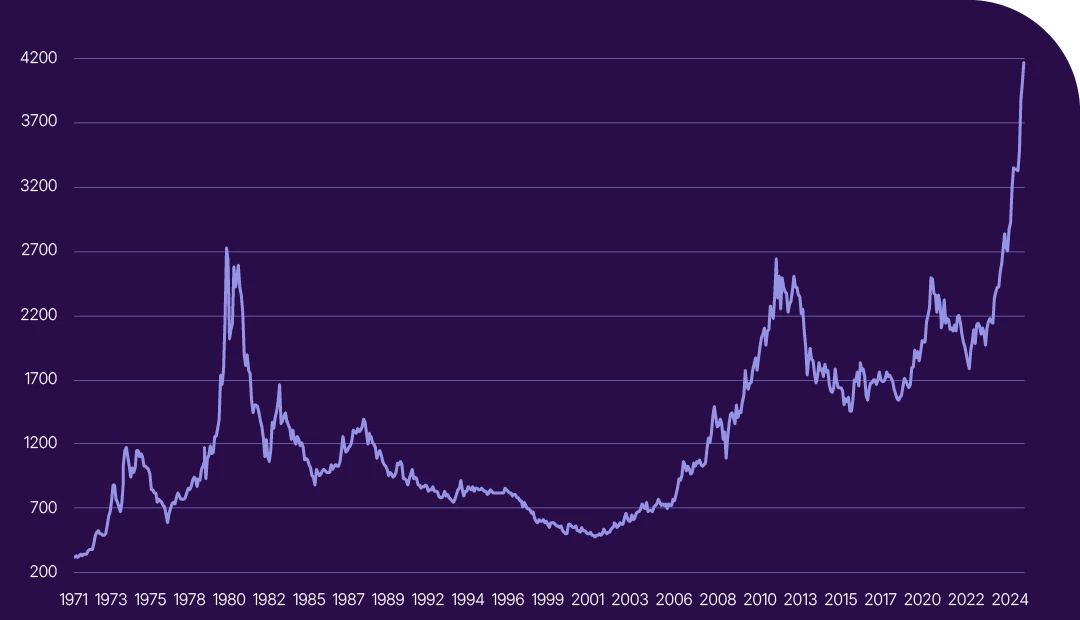
So how do we value gold? After all, it produces no income, interest or dividends, so we can’t use standard measures such as cash flow analysis. Many years ago I worked for a company whose Chief Investment Officer was South African, a native of the country where around half of all gold mined globally originates. To value gold, he took a deliberately simple approach and would look at the price today relative to the average real price of gold since 1971 – when President Nixon ended the agreement that tied the value of currencies to gold – see chart below. If the current price was at the high end of the range he would be less attracted to it, and if at the low end, more so.
Real, inflation-adjusted price of gold (US$/oz)
Source: Canaccord Wealth, Bloomberg
Until 2022 this seemed to work, but then something changed. Over a period of more than 50 years, in today’s terms, the price of gold ranged between around US$500/oz and US$2,700/oz. So at the end of 2022, with the real price at around US$2,200/oz, I imagine my wise old colleague would have been inclined towards not liking gold very much.
However, this would have been a mistake. In the last three years, the price of gold has risen by almost 130% and our Roman centurion is now paid the same amount as a US army captain, rather than a sergeant. In all recorded history, gold has never been so expensive.
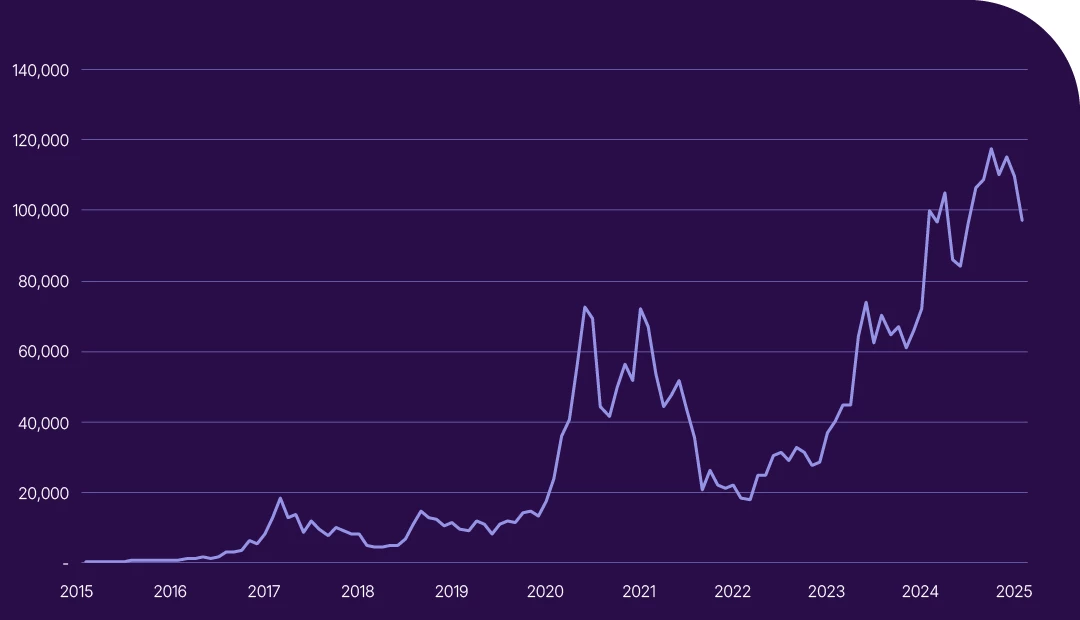
And it isn’t just gold: as illustrated in the chart below, over the last 10 years another asset has enjoyed an even more stellar performance – Bitcoin.
Real, inflation-adjusted price of Bitcoin (US$)
Source: Canaccord Wealth, Bloomberg
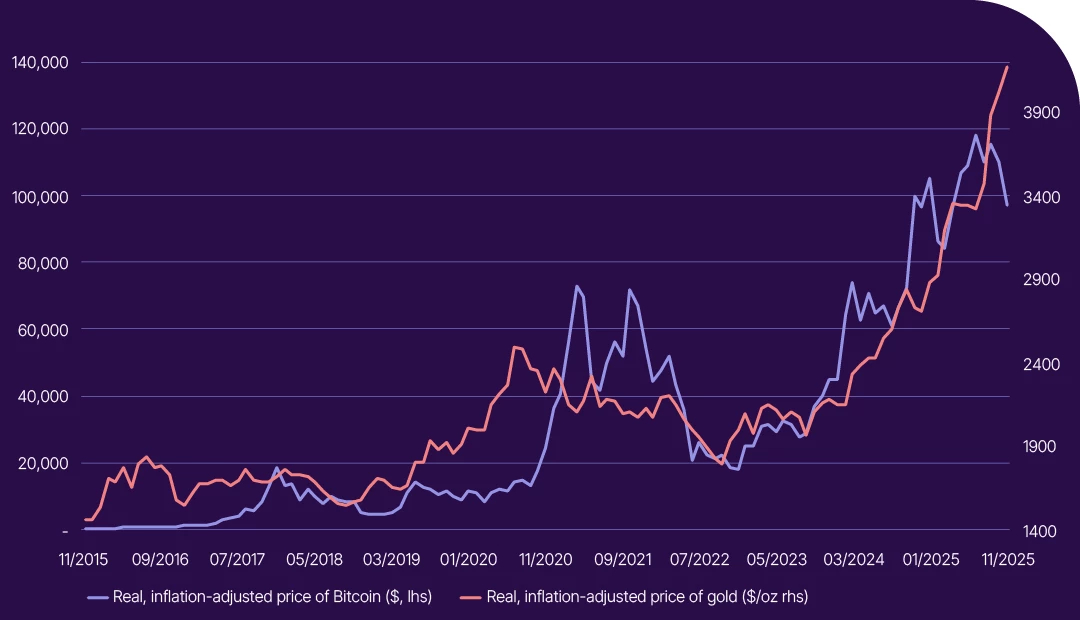
The similarity becomes clearer when we put them on the same chart, although Bitcoin’s increase has been around 100 times greater than gold.
Real, inflation-adjusted price of gold (US$/oz) vs Bitcoin (US$)
Source: Canaccord Wealth, Bloomberg
So what's been going on?
The ever-increasing government debt burden
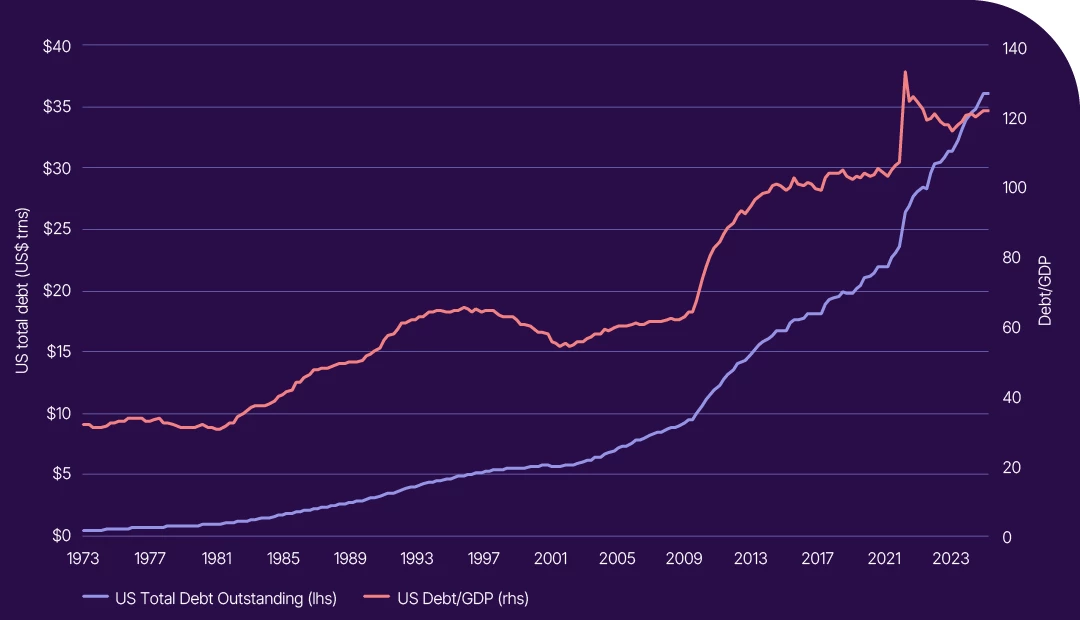
One of the risk factors we have consistently highlighted over the last few years has been the unsustainable nature of government debt. The chart below shows the progression of US government debt since the early 1970s. US federal debt has now risen to US$37.6trn and has climbed over the last year by around US$175bn every month, or US$67,000 every second.
US debt growth has accelerated since the Global Financial Crisis
Source: Canaccord Wealth, Bloomberg
Studies have concluded there is a limit to the ‘healthy’ ratio of debt to Gross Domestic Product (GDP), above which economic growth is stymied, estimating this limit at between 80% and 90%.
|
|
2024 debt: GDP |
2010 debt: GDP |
Change |
|
Japan |
255% |
206% |
+49% |
|
Italy |
140% |
119% |
+21% |
|
United States |
123% |
95% |
+28% |
|
France |
112% |
85% |
+27% |
|
Canada |
106% |
84% |
+22% |
|
United Kingdom |
104% |
74% |
+28% |
|
Germany |
64% |
82% |
-18% |
Source: International Monetary Fund
Higher levels than this are thought to:
- Reduce the flow of investment into other parts of the economy
- Make investors demand higher interest rates
- Raise the vulnerability of economies to economic shocks
- Increase the burden of debt interest on governments: for example, in the US in 2025 federal debt service is estimated to come to US$1.2trn or 17% of the overall federal budget.
Governments around the world are in no position to stop the trend to higher debt. Populations are ageing, and economic growth in many places is weak, both of which make paying down debt more difficult. And with the spectre of Russia and China hanging over our collective security, it would not be popular to reduce defence spending, a big component of forecast future government outlays.
As you can see from the table above, Germany is the only G7 country with a sustainable level of debt right now and the only country where the level as a percentage of GDP has fallen over the last 15 years. However, its new government is planning an enormous spending splurge on infrastructure (€500bn over 10 years) and defence (a rise from €62bn annually today to €150bn by 2030).
Markets are worried: is there a plan for dealing with this surge in debt? Apparently not. The can is being kicked further and further down the road for future governments and taxpayers to deal with.
Why investors are favouring assets that aren’t connected to paper money
Investors no longer accept the can-kicking. They fear that this problem might be addressed by tolerating more inflation. Higher inflation means interest rates would have to go up, not down as currently expected; equity valuations are high, and would have to come down markedly, and bond prices would fall as interest rates rose.
After 2022, when everything fell, apart from gold, in reaction to a rise in previously artificially low interest rates, investors are much keener to hold an asset that keeps its value when others fall.
Since 1971, currencies have not been backed by gold, but by so-called ‘fiat’ or paper money, which is created by central banks but has no intrinsic value beyond the creditworthiness of the issuer. If central banks are going to debase these currencies and destroy their creditworthiness, investors will turn to assets over which central banks have no influence – like gold and cryptocurrencies.
Add that to a move by strategic competitors like China and Russia to diversify assets away from US control, and one can see why this time it’s been different – at least for now.
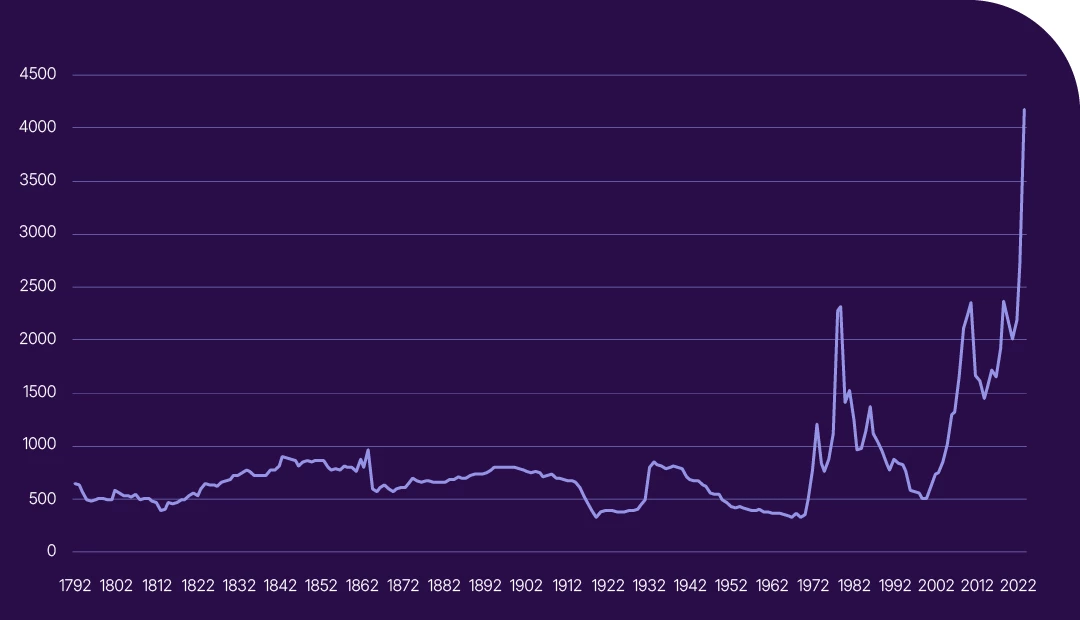
And it isn’t simply a reversion to a longer-term valuation range from before 1971. We have good information at least as far back as 1792.
Real price of gold (US$/oz) since 1792
Source: Canaccord Wealth, Bloomberg, Engelhard’s Gold Price Quotations
This chart clearly shows that the launch of fiat money in the 1970s broke the price of gold out of a lower long-term band. And the explosion of government debt in the last few years may have broken the higher, post-1971 band as well.
What does this mean for investors?
Gold (and Bitcoin) breaking out like this is not a good sign. It shows investors are prepared to pay the highest real price in all recorded history as an insurance policy against conventional asset markets blowing up in the face of rising government debt and the possibility of increasing inflation.
Adding protection to our client portfolios
Thankfully, at Canaccord Wealth, we aren’t in that dark place yet. As discussed in our accompanying Investment Outlook article, shorter-term inflation seems to be behaving reasonably well, interest rates are continuing their downward trajectory and company earnings are very, very strong. This is good news, because valuations are high, especially in equities.
So at the moment we see the astonishing performance of gold (which we hold in many client portfolios) as less like a canary in the coal mine, and more as a sensible insurance policy. When we drive our cars or buy houses we all take out insurance, just in case. It costs us money, but if needed when bad things happen, it’s an invaluable asset.
We are here to help
If you would like to discuss how your own portfolio is positioned to meet your long-term goals, please get in touch with your usual Canaccord Wealth account executive or email: enquiries@canaccord.com
For further information on any of the terms used in this article please see our glossary of investment terms.

Our Investment Outlook for December 2025
In our latest Investment Outlook, Thomas Becket, our Co-Chief Investment Officer, explains how we are bolstering our investment portfolios against a range of possibilities in 2026.


